


Speak with an expert and get to know our technology.
COLLABORATE WITH US





January 15, 2026
Using the Venezuela case, Alto documents the reuse of pre-positioned FIMI cognitive infrastructure, where identical RT-sourced narratives were globally syndicated through "pink-slime" proxy media to manufacture localized legitimacy at scale.

In January 2026, Alto published an analysis of synchronized drone disruptions across European airspace, documenting how kinetic events were rapidly followed by pre-positioned narrative infrastructure designed to exploit verification gaps and impose asymmetric costs on critical infrastructure operators. Days earlier, during US military operations in Venezuela, Alto observed the same network reactivating—demonstrating how previously identified cognitive infrastructure adapts regionally and responds almost immediately to unrelated kinetic triggers.
Many of the cognitive and narrative campaign TTPs surfaced during the Venezuela case align with the primary DISARM-mapped behaviors identified in the European airspace analysis, reinforcing that this activity is neither episodic nor improvised. Rather than reflecting new campaign design, the Venezuela operation illustrates the reuse of an existing, scalable narrative ecosystem capable of rapid redeployment across languages and geographies.
As in Europe, publication volume was not primarly driven by official state outlets, which accounted for only a small fraction of total output. Instead, the majority of amplification originated from the same News.Net proxy media network—consisting of over 460 interlinked, local news-like domains—identified during the European airspace analysis, providing an industrialized amplification layer optimized for speed, localization, and deniability. This model enables near-immediate saturation following kinetic events, seeding narratives before institutional verification or coordinated responses can materialize.
Critically, beyond the risk of any single narrative the inorganic amplification and coordinated reuse of cognitive infrastructure that allows these narratives to scale instantly across polarized information environments presents the principal risk vector for organizations. For public institutions, this erodes response credibility during early incident windows; for private operators, it compounds operational, reputational, and market risk by shaping perception before facts stabilize, making cognitive exposure a shared vulnerability across sectors.
.png)
Between January 3rd and 4th, 2026, Alto's AI agents captured, indexed and analyzed a total of 2,052 articles published across 290 News.Net media outlets discussing the US military operation in Venezuela in real-time. Analysis of this coverage revealed a coordinated deployment of recurring narratives that appeared rapidly, scaled across localized domains, and persisted throughout the initial 24–48 hour window following the operation.
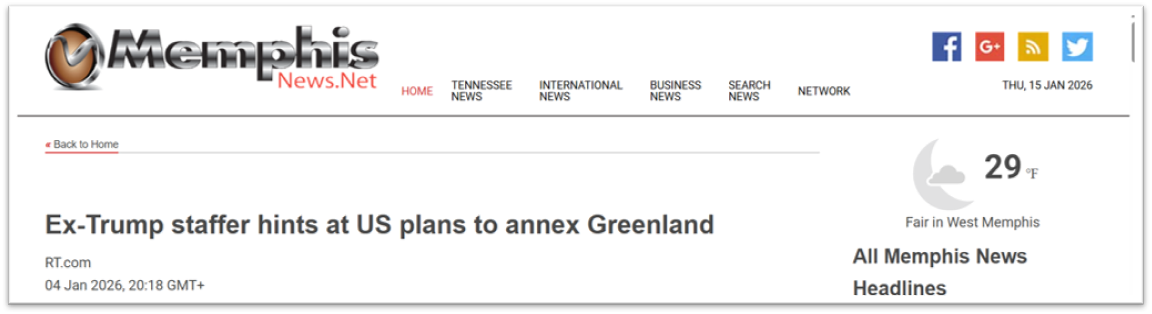
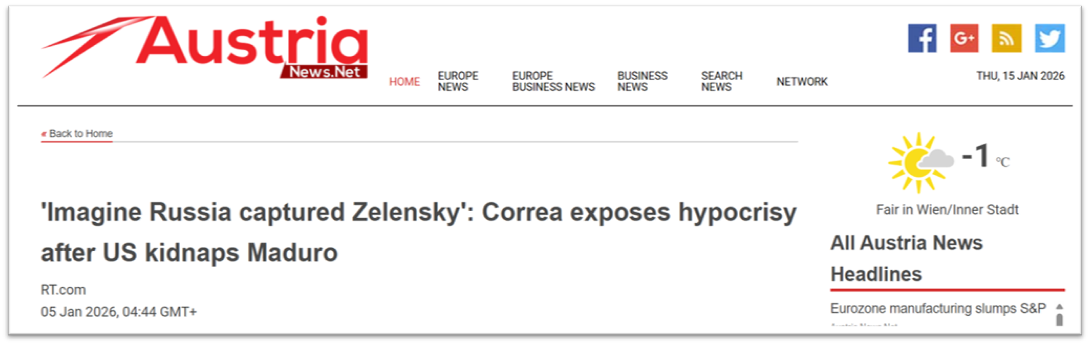
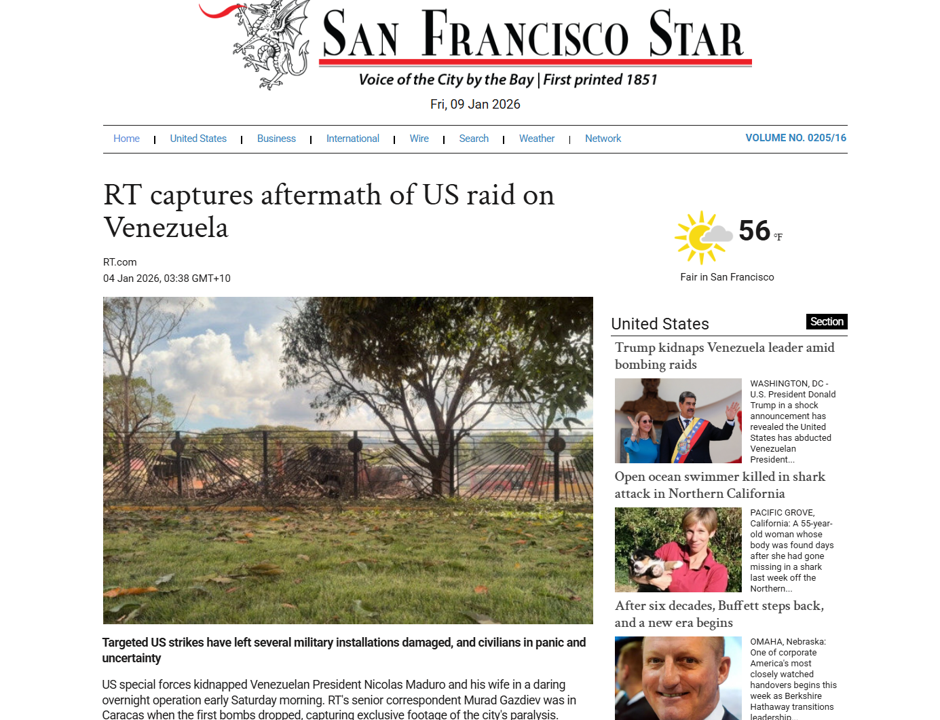
This is an example of the pink-slime model in full effect: identical articles deployed at massive scale across hundreds of local-looking domains, published in tight sequences—often at the exact same timestamps. Place names, geographic keywords, and minimal surface variation are used not to inform local audiences, but to exploit indexing, credibility heuristics, and regional discovery pathways. These sites function as an industrial syndication layer—alternatively described as a sanitization, repackaging, or distribution masking mechanism—allowing RT-origin narratives to be replicated, legitimized, and circulated globally under the appearance of independent local media.
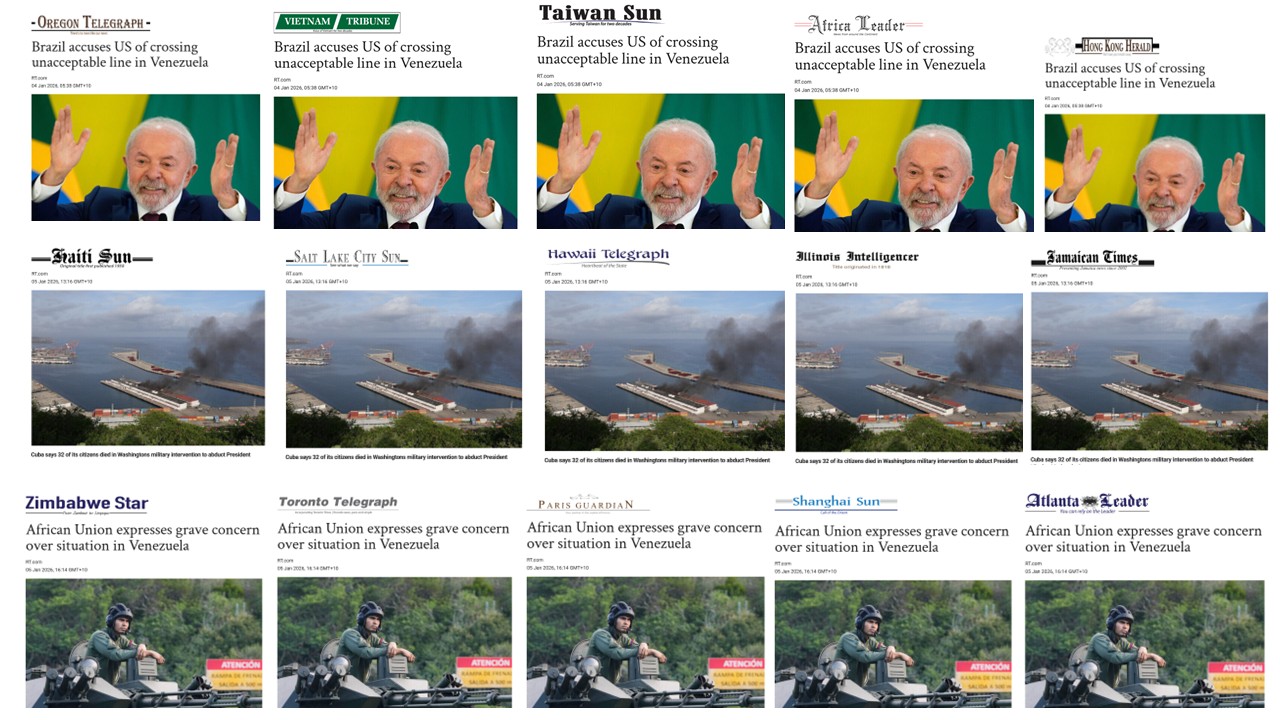
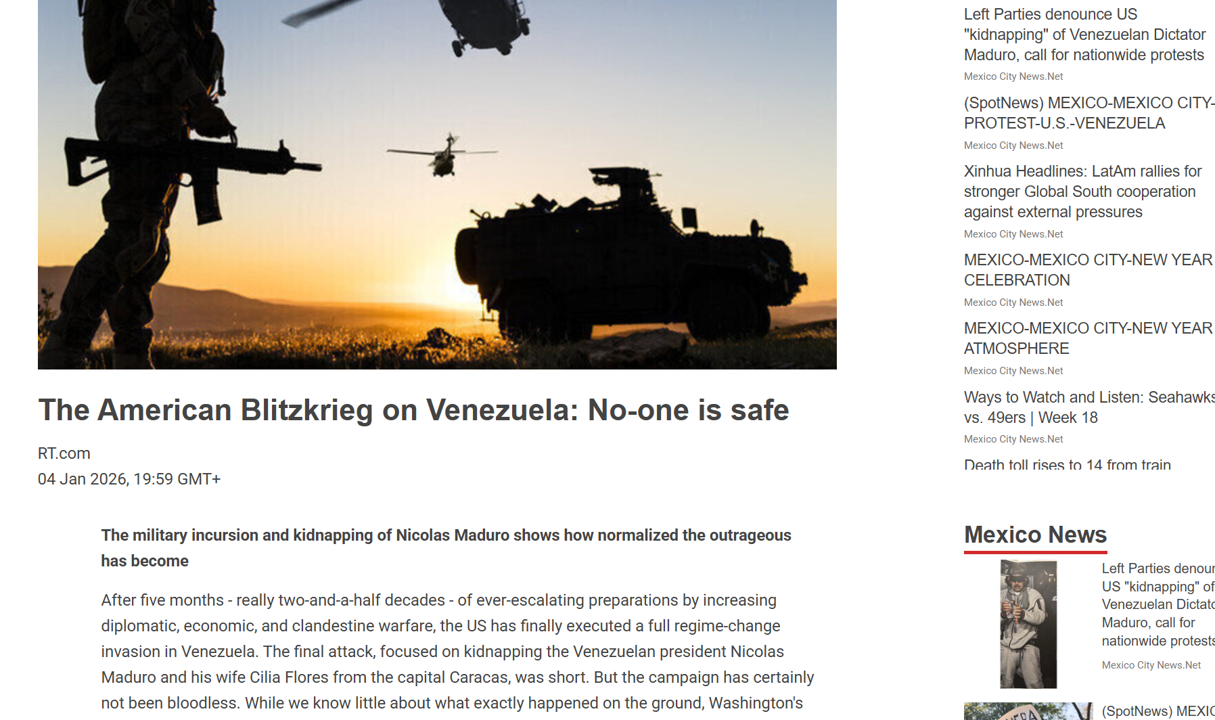
This narrative emphasized a destabilizing aggressor taking illegal military action against a “democratically elected” leader. Citing official condemnations from Beijing and Moscow, the messaging contrasted Western-led “regime change” with examples and claims of peaceful and multipolar strategic partnerships of the East. The narrative leveraged the formal rejection of the operation by Brazil, Colombia, and Mexico—who labeled the raid an “unacceptable line” and a violation of the UN Charter—to isolate Washington and portray the United States as a rogue actor acting independently and in defiance of its own regional neighbors.
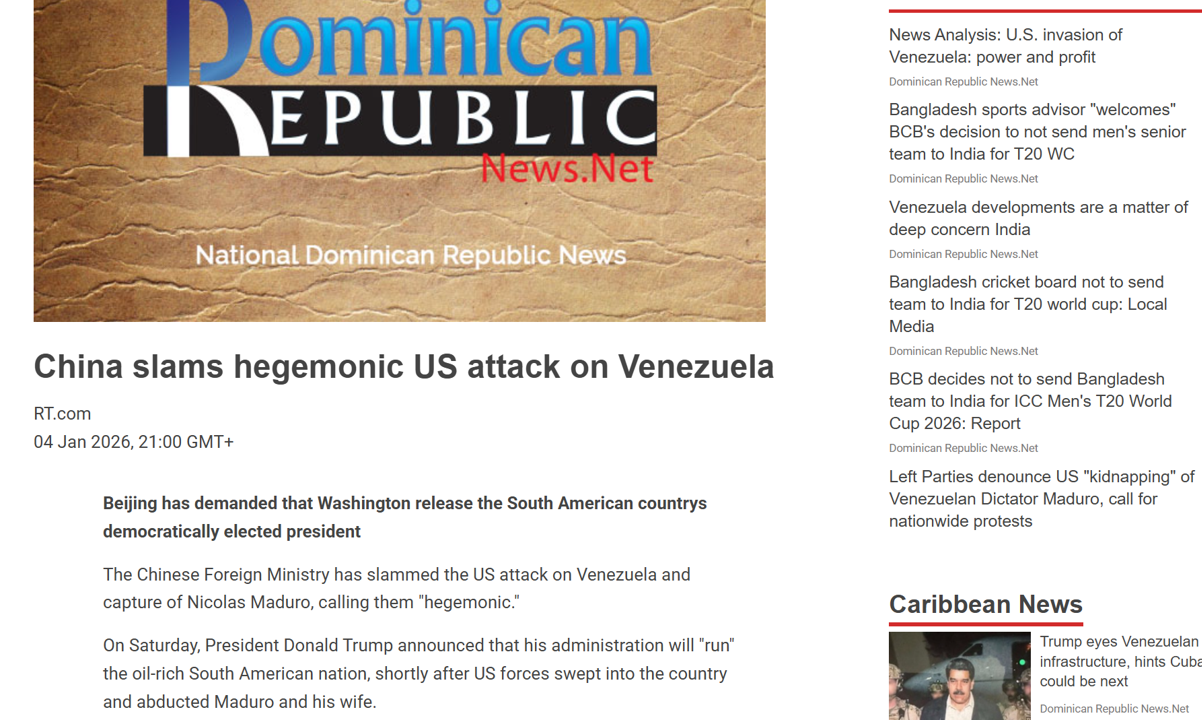
This narrative characterized the military incursion as a criminal act driven by the desire to seize Venezuelan oil and gold reserves, rejecting the legitimacy of any law enforcement action. Narco-trafficking charges were dismissed as “flimsy pretexts,” while opposition figures were mocked as discarded puppets. The objective of this framing was to reinforce the portrayal of the United States as a predatory state operating outside accepted norms.
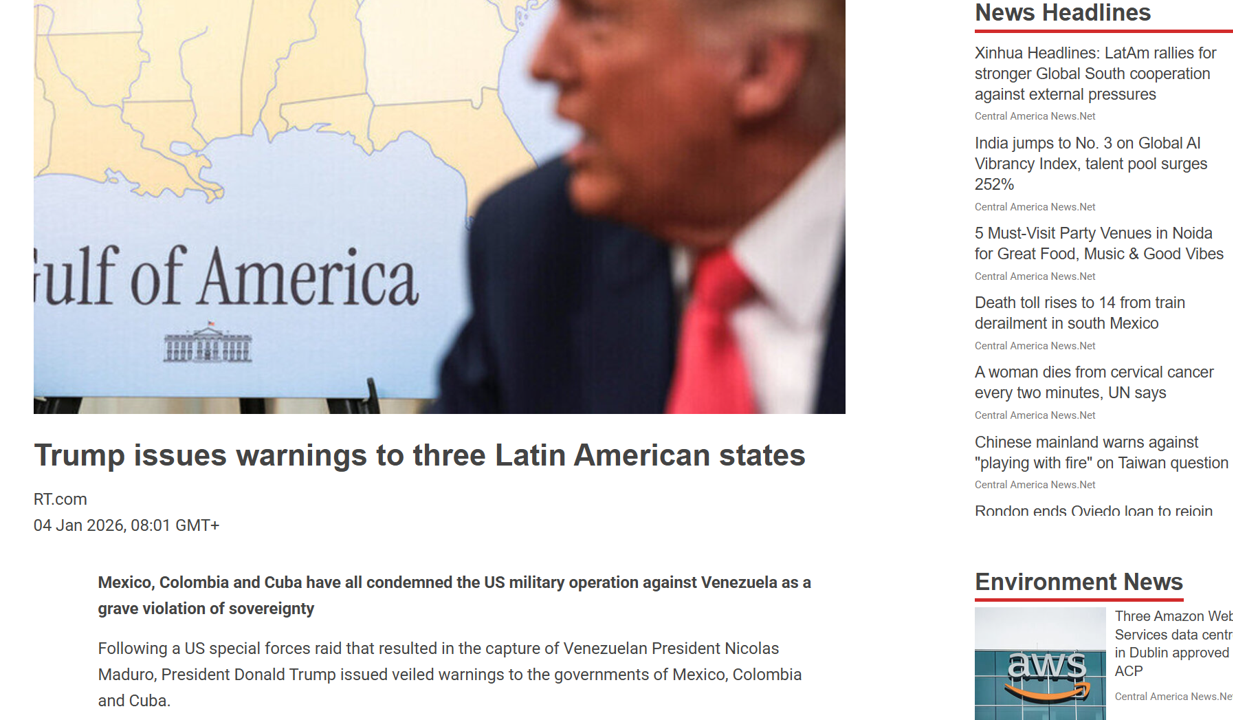
Focusing on threats directed at Mexico, Colombia, and Cuba, this narrative portrayed the United States as a lawless bully targeting sovereign neighboring states. By framing regional leaders as potential victims of imperial “hit lists,” the narrative sought to stoke fear across Latin America and consolidate opposition into a regional “zone of peace” positioned explicitly against Washington’s influence.
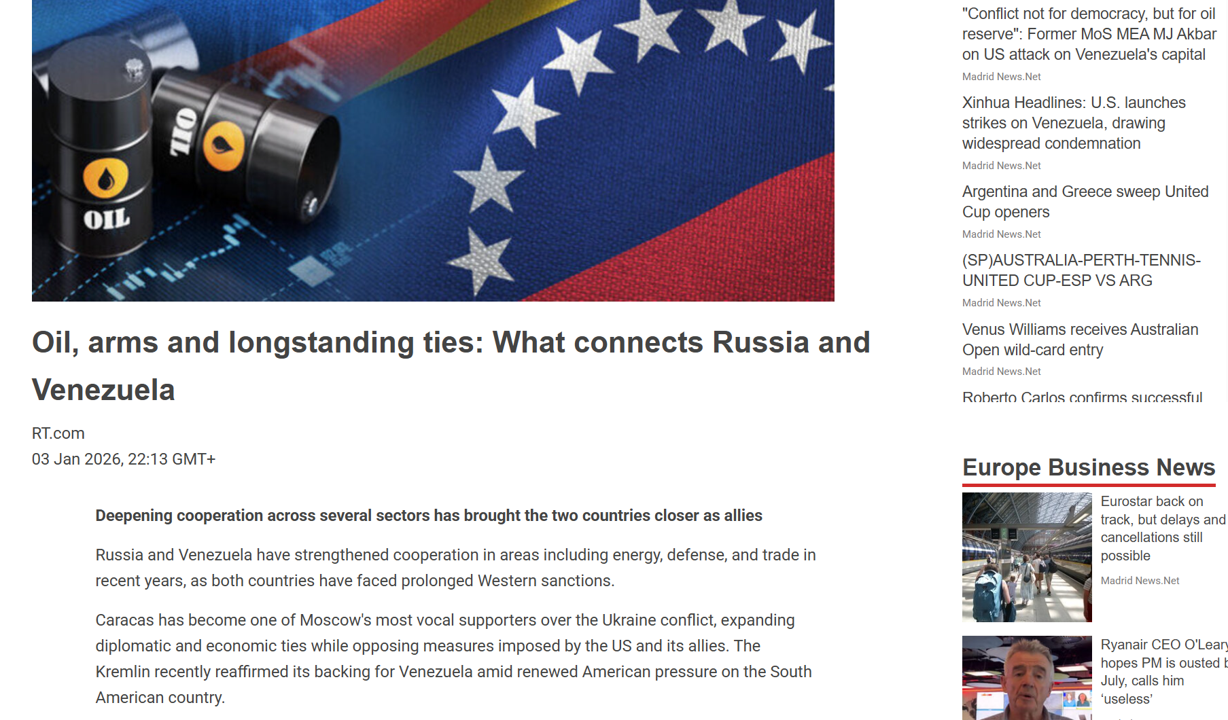
This retrospective narrative emphasized the depth of integration between Moscow and Caracas, highlighting long-term oil agreements and the use of the Mir payment system. The operation was framed not as a pursuit of democracy or security, but as a targeted strike against a stabilizing Russian strategic partner, intended to disrupt non-Western financial and energy cooperation and weaken alternative economic alignments.
By amplifying statements from Slovak Prime Minister Robert Fico, this narrative argued that the United States had rendered the United Nations and international law obsolete. The use of a European political voice served to validate the characterization of the US as a “rogue superpower,” suggesting that powerful states now act with total impunity and that the post-World War II international order is collapsing—thereby justifying a global shift toward multipolar resistance.

This narrative relied heavily on on-the-ground, user-generated footage depicting smoke, damaged infrastructure, and panicked civilians. By emphasizing shortages, panic-buying, and visible destruction, the framing shifted attention away from strategic or legal considerations toward visceral human suffering. The objective was to incite emotional backlash and portray the US military as a source of criminal destruction, humanitarian instability, and moral failure.
The Venezuela case did not introduce new narrative mechanics or coordination models. Instead, it reinforced a central finding from Alto’s earlier work: contemporary hybrid operations rely on massively syndicated narrative infrastructure, not bespoke or event-specific campaigns. In Venezuela, identical articles were deployed at scale through the same proxy media ecosystem previously observed in other theaters, demonstrating that amplification capacity—not narrative novelty—is the primary operational asset.
Rather than evolving messaging tactics, the operation leveraged an established distribution layer. Hundreds of News.Net domains functioned as a high-volume syndication network, republishing the same RT-origin content across localized, news-like sites to create the appearance of widespread, independent coverage. This industrial replication transforms single source narratives into sustained global presence through scale alone.
The consistency of this behavior across regions indicates operational reuse, not adaptation. Narrative assets and amplification pathways operate as standing infrastructure—pre-positioned, immediately activatable, and optimized to flood information environments during early verification gaps. In this model, speed and volume, not persuasion or narrative sophistication, determine dominance—allowing perception to be shaped before institutional responses can meaningfully engage.
The Venezuela case reinforces a shift already evident in European airspace disruptions: kinetic incidents are now reliably followed by immediate, automated narrative amplification through pre-positioned cognitive infrastructure. This dynamic compresses response timelines and ensures that perception is shaped before verification, attribution, or coordinated messaging can occur.
For defense and security institutions, this creates a persistent exposure window in which operational decisions, public communications, and alliance credibility are contested in parallel with physical response. For critical infrastructure operators and private entities, the same dynamic translates into reputational, market, and regulatory risk—often triggered by events outside their direct control but amplified through synthetic media and proxy networks.
As these narrative systems are reused across regions and crisis types, cognitive exposure becomes a shared operational risk. Mitigating it requires treating narrative amplification and synthetic media not as downstream communications challenges, but as integral components of incident response, resilience planning, and cross-sector coordination.
👉 Talk to our team to learn how Alto leverages over 700B signals annually to map and monitor cognitive attack infrastructure at scale, enabling early detection of synthetic narrative amplification across regions.