


Speak with an expert and get to know our technology.
COLLABORATE WITH US





January 9, 2026
Alto’s Cognitive Threat Intelligence AI Agents expose how Kremlin influence operations and narrative attacks are rapidly shifting to new “local-looking” digital touchpoints—an ecosystem underpinning Russia’s FIMI and closely linked to its kinetic drone campaigns.

When drones began appearing over major European airports last autumn, the immediate consequences were visible and familiar: grounded flights, closed airspace, delayed passengers, emergency protocols activated. What was less visible, but far more consistent across cases documented in this report, was what followed in the information environment. This is not a story about drones alone. It is about how minor kinetic incidents are intentionally operationalized to gain cognitive advantage, and how institutional response timelines are systematically leveraged as part of that strategy.
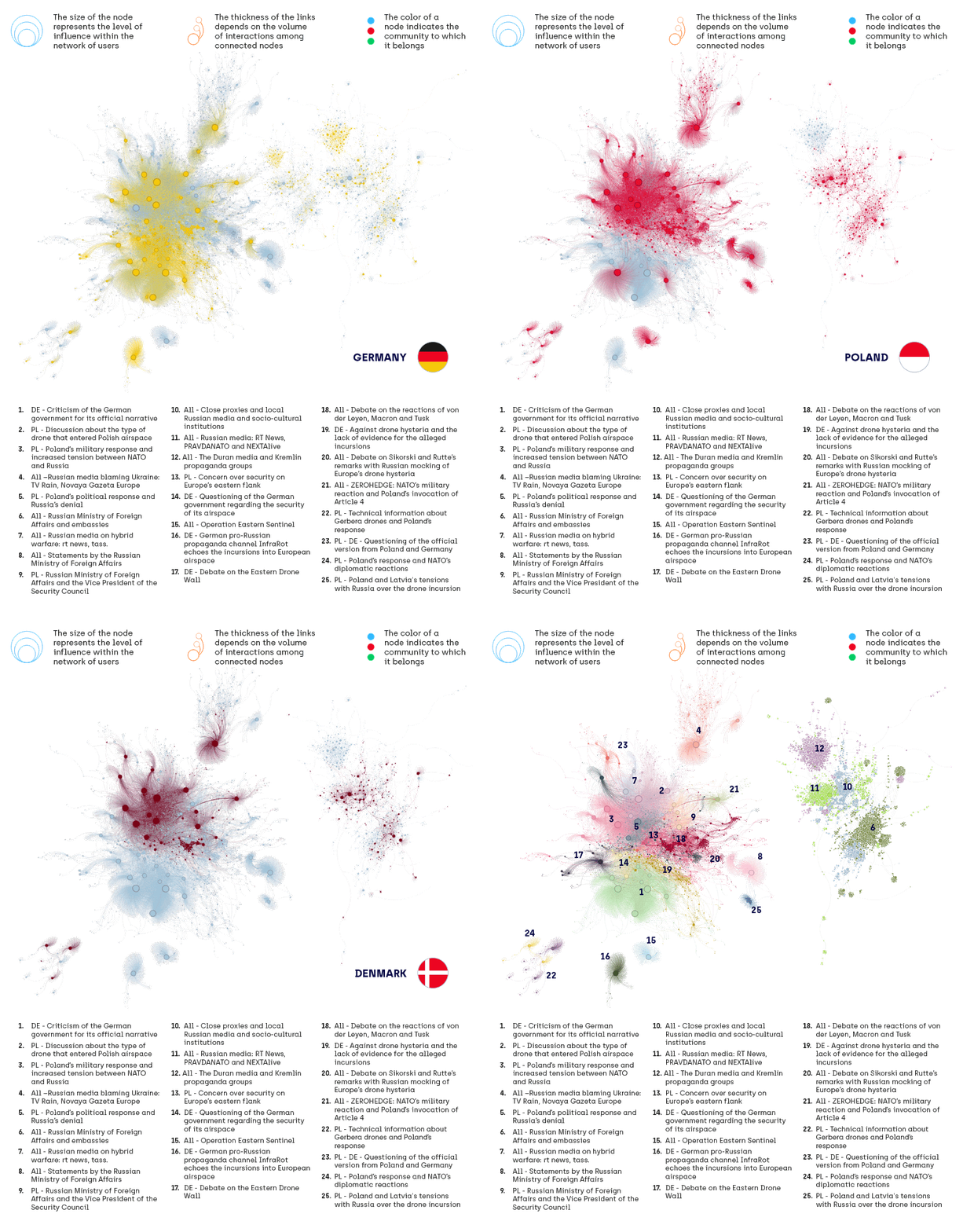
Across incidents in Poland, Denmark, and Germany, the same sequence unfolded with striking regularity. Within 15 to 45 minutes of the first airspace restrictions, coordinated narratives began circulating across messaging apps, niche websites, and social platforms. Before authorities issued verified statements, explanations were already being offered, responsibility reassigned, and institutional competence openly questioned.
By the time official responses arrived, often four or more hours later, public interpretation had largely settled. While details varied by country and language, the underlying structure remained constant. Limited physical disruption repeatedly evolved into something more deliberate: synchronized kinetic and cognitive activity designed to exploit verification gaps and establish early narrative dominance. Alto’s analysis uncovered comparable timing and proxy infrastructure dynamics in other geopolitical contexts, including recent incidents outside Europe, reinforcing that this pattern reflects a transferable operational model rather than a localized anomaly.
Alto Intelligence analyzed three country cases between September and November 2025 in which drone-related kinetic disruptions occurred across multiple instances, including airspace restrictions and temporary shutdowns at major European airports such as Warsaw Chopin, Copenhagen, and Munich, as detailed in the report. Each case generated immediate operational and economic impacts, creating conditions for parallel activity in the information environment.
Rather than adjudicating the truth of individual claims, Alto’s cognitive threat intelligence analysts focused on timing, coordination, and amplification dynamics. Nearly fifty-thousand digital signals were examined across social platforms, messaging applications, niche forums, alternative media, and deep and dark web environments, including video, audio, image, and news content in multiple languages.
Each case was mapped as a hybrid operational sequence, linking kinetic triggers to subsequent cognitive activity. Behaviors were structured and analyzed using the DISARM framework to identify which tactics and techniques consistently drove operations across cases and which played supporting roles. This mapping enabled cross-case comparison, reduced reliance on anecdotal indicators, and surfaced repeatable activation patterns that would not be visible through platform- or incident-specific analysis alone.
This work combined analyst-led assessment with Alto’s Cognitive Threat Intelligence AI Agents, which detect and classify coordinated influence activity in near real time. Together, this approach made it possible to connect physical disruption and information operations as parts of a single operational logic rather than parallel phenomena.
Across all three country cases, the same sequence unfolded with remarkable consistency. Alto’s analysis did not treat these as isolated reactions, but as a repeatable progression of actor roles entering the information environment at predictable intervals.
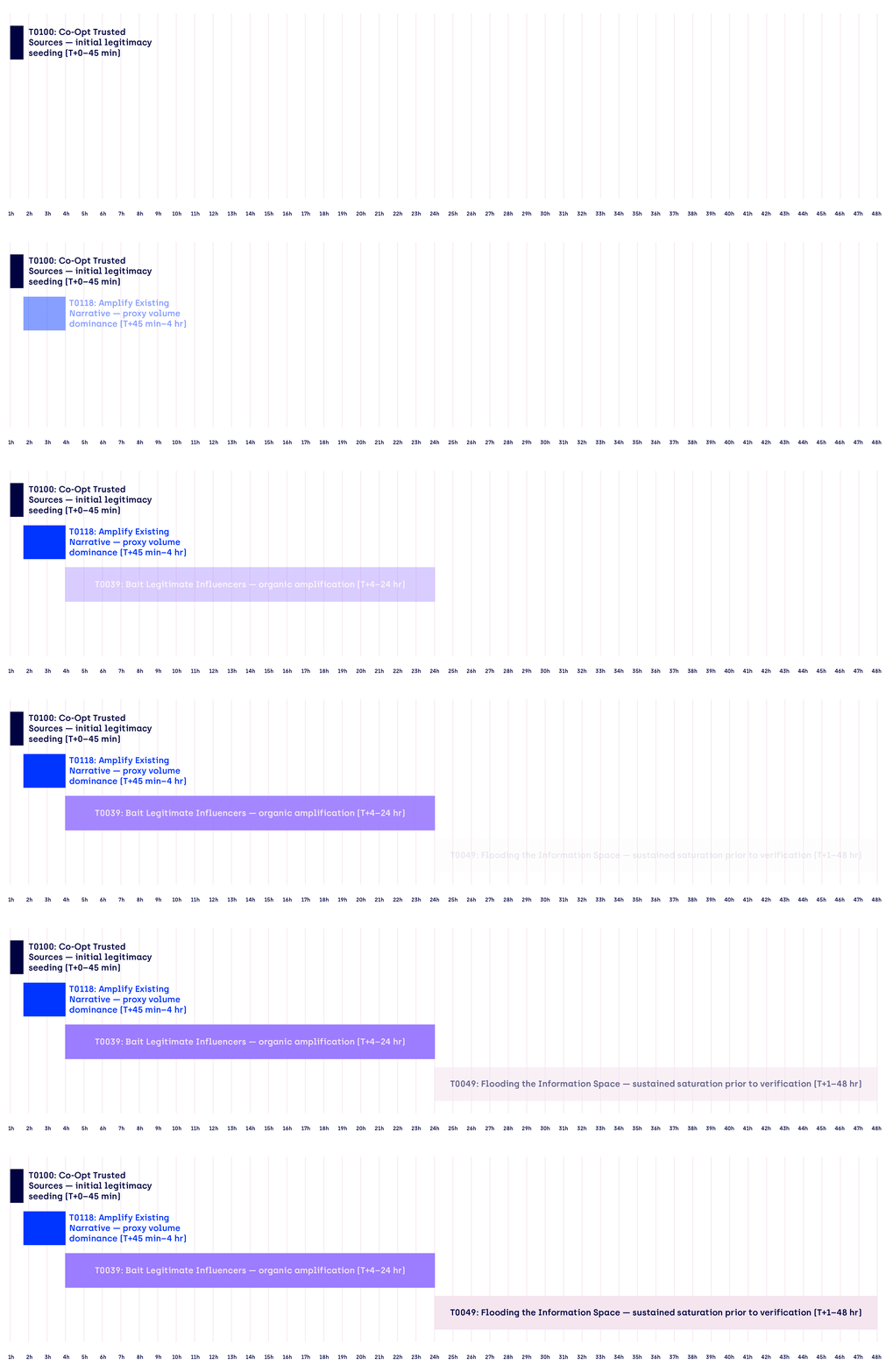
First came the trigger: drone sightings, airspace closures, emergency responses. Within minutes, narratives began circulating from a narrow set of early actors operating in low-visibility digital spaces. These initial claims framed incidents as provocation, misattribution, or manipulation, often before any verified details were available.
Amplification followed within one to four hours. Alto identified a broader layer of proxy outlets and multilingual channels that expanded these framings across platforms, shifting attention away from what had occurred toward what the incidents were said to reveal about institutional weakness, overreaction, or strategic incompetence.
As time passed, a third layer entered. Influencers and pseudo-expert voices normalized the disruption, portraying defensive measures as routine, exaggerated, or economically irrational. Official statements and denials appeared only after narrative saturation had largely taken hold.
Across languages, platforms, and national contexts, the sequencing and the actor roles remained consistent, indicating a structured deployment model rather than spontaneous public reaction.
Alto’s analysis mapped this sequence consistently across incidents. What makes these incidents analytically significant is not just repetition, but orchestration. Across cases documented in the full report, Alto mapped a recognizable cognitive kill chain:
• A physical trigger created uncertainty.
• Narratives were seeded during the verification gap.
• Amplification followed through proxy networks.
• Normalization reframed disruption as overreaction.
• Official denial arrived after saturation.
This sequencing reflects deliberate exploitation of institutional confirmation cycles. Speed, rather than scale, establishes narrative advantage. By the time facts stabilize, cognitive frames are already set. A visual breakdown of this sequence and supporting evidence is available in the full analysis.

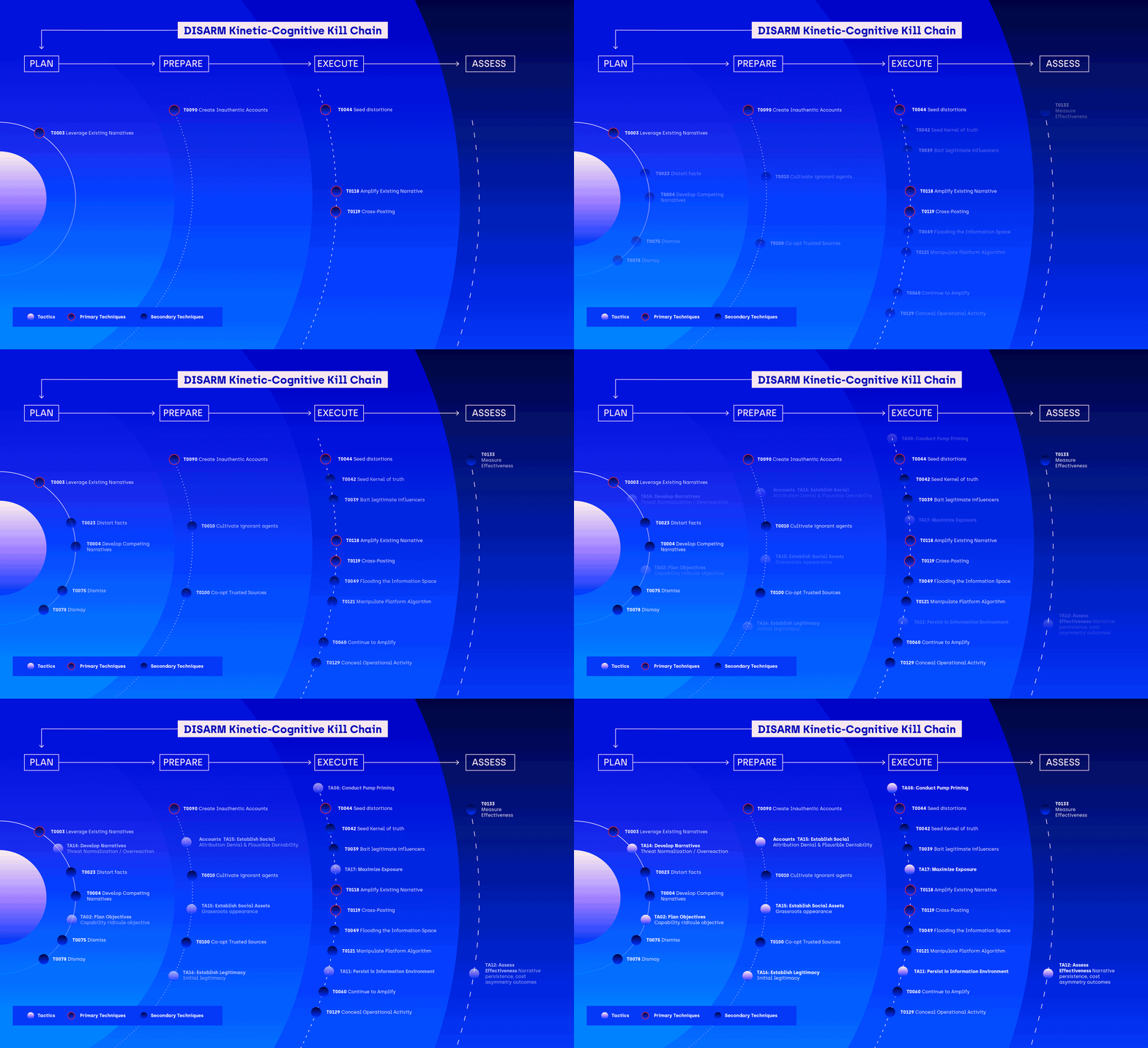
Across the cases analyzed in the report, a consistent cognitive deployment sequence was identified. During the first hour following airspace restrictions, official channels were typically silent. During the first several hours, statements remained partial or provisional. Within that window, Alto mapped these early narratives gaining traction in real-time with little competition from authoritative information.
What followed was not random misinformation. In each case, early explanations anchored public interpretation before verification entered the cycle. Once a frame aligned with existing skepticism took hold, later corrections did not reset perception. They competed with narratives that had already achieved significant dissemination across diverse digital media ecosystems.
Alto’s analysis shows that early narrative deployment consistently began in low-visibility environments, particularly Telegram. Initial framing appeared within 15 to 45 minutes of kinetic events, before spreading across Facebook, VK, Bluesky, YouTube, and alternative media. Across cases, these channels established baseline interpretations within one to four hours, well before institutional verification cycles completed. By the time official statements were issued, narratives had already stabilized across multiple platforms.
Further, a small number of domains and proxy actors repeatedly outperformed their apparent size, flooding information ecosystems during verification gaps. This model preserves plausible deniability while achieving rapid saturation before institutional responses can cohere.
Institutional response systems are designed for accuracy. Verification takes time; coordination takes longer. In incidents involving civilian infrastructure and security risk, caution is unavoidable.
But that caution creates a predictable window. During the first hour, official channels are often silent. During the first four hours, statements are partial. Within that window, early narratives face little competition from authoritative information.
Psychologically, early explanations anchor interpretation. Once a frame takes hold—especially one aligned with existing skepticism—later corrections do not reset perception; they compete with it. What we observed was not isolated misinformation, but the rapid establishment of baseline public interpretation before verification entered the cycle.
Beyond immediate influence effects, Alto’s analysis shows that high-volume proxy news infrastructure creates longer-term risks for information integrity. At scale, these networks do more than amplify narratives during individual incidents. They inject persistent content into the open web that shapes what people, institutions, and machines encounter over time.
The News.Net network illustrates this dynamic. Publishing more than two million articles per month, with a significant subset directly referencing Russian state media, the network systematically feeds web-indexed content that surfaces in search results, digital knowledge bases, and Large Language Model training corpora. Once embedded, this material continues to circulate long after the original triggering event has faded from public view. Alto’s analysis has since identified the same Russian-aligned proxy networks and narrative infrastructure active in response to a recent U.S. military operation in Venezuela, demonstrating how these kinetic–cognitive techniques are adapted and redeployed across regions rather than confined to a single theater.
The effect is cumulative. Narratives initially deployed to exploit short verification gaps become laundered into baseline reference material, influencing how future events are interpreted and retrieved. As AI systems increasingly mediate information access, content replication at this scale functions as strategic infrastructure for long-term cognitive influence, not simply as a tactical tool for short-lived campaigns.
This shift extends the impact of kinetic-cognitive operations beyond moments of crisis. Influence is no longer limited to shaping immediate perception. It also shapes the informational environment that future audiences and automated systems rely on to make sense of the world.
None of what Alto documented required advanced technology or mass participation. It relied on synchronization, pre-positioned narratives, and a precise understanding of how institutional response timelines create exploitable gaps under uncertainty.
Information dominance in these incidents was not accidental. It was engineered. Across cases, the 15 to 45 minute cognitive deployment window consistently functioned as a force multiplier, allowing minor physical disruptions to produce durable perception-shaping effects that outlasted the incidents themselves.
In hybrid environments, the first credible narrative establishes the baseline from which all subsequent information is judged. By the time verification arrives, reality has often already been framed.
For public authorities, infrastructure operators, and private organizations embedded in these ecosystems, this is no longer a theoretical risk. It is an operational challenge that sits at the intersection of security, communications, and resilience. Closing this gap requires visibility into how kinetic disruption, narrative deployment, and amplification infrastructure interact in real time. Alto’s Cognitive Threat Intelligence is designed to provide that visibility.