


Speak with an expert and get to know our technology.
COLLABORATE WITH US




March 9, 2026
Alto ran its cognitive threat intelligence infrastructure against Mining Indaba's Top 10 Trends for 2026, mapping tens of thousands of digital signals across 50+ languages to identify how APMs, state-aligned actors running coordinated narrative operations, are targeting mining governance and investment narratives across Africa, Latin America, Central Asia, and the Indo-Pacific.
When a supervisors' union negotiation at one of Chile's largest copper operations reached deadlock in late 2025, the immediate consequences were familiar: the prospect of a full operational halt, regulatory scrutiny over water management, stalled stakeholder confidence. What was less visible was what happened next in the information environment. Within 72 hours, the negotiation had been reframed across three language environments, from a contained labour action into evidence of structural copper scarcity tied to AI infrastructure demand. Spanish-language regional media focused on "resource sovereignty" and water rights. Mandarin-language industry forums repositioned it around supply chain fragility. English-language commodity desks were last. By the time they registered the story, the framing had already shifted, with copper trading above ~$12,500/t, at or near record highs, in a market where narrative-driven supply disruption signals carry immediate pricing consequences.
This is not a story about a single event. It is about how operational realities across the mining sector are being systematically amplified, reframed, and redistributed by state-aligned and state-affiliated actors, Advanced Persistent Manipulators (APMs), to reshape how narrative threats are perceived by the investors, regulators, and partners whose decisions determine a project's future.
Days before this briefing was published, OpenAI banned accounts linked to Rybar, a Russian military-aligned network founded by a former Russian Defence Ministry press officer, with over 1.5 million Telegram subscribers. OpenAI identified Rybar using ChatGPT to generate multilingual propaganda, draft covert interference campaign plans targeting Africa, and develop proposals for election interference teams operating across the continent. The plans included managing social media accounts, launching bilingual investigative journalism outlets focused on African geographies, organising paid placements in French-language media, and building networks of local agents for on-the-ground influence operations. Estimated budgets for a single African campaign reached $600,000 per year.
Rybar is not a peripheral actor. It features prominently in Alto's analysis of cognitive and narrative operations targeting West African gold jurisdictions, where it distributes targeted disinformation campaigns framing Western mining operators as destabilising foreign presences. The OpenAI findings confirm what Alto's monitoring has tracked across this briefing: APM networks targeting mining governance in Africa are well financed and are industrialising their operations, using AI to scale multilingual content production, synthetic amplification, and coordinated distribution across platforms that conventional monitoring does not reach.
Mining Indaba is Africa's leading mining investment conference bringing together over 10,000 attendees in Cape Town each February. In February 2026, Mining Indaba published its Top 10 Trends for 2026, including copper supply competition, gold jurisdictional volatility, ESG pressure on battery metals, resource nationalism across critical minerals, iron ore decarbonisation pressure, coal phase-out dynamics, joint venture fragility, automation risk, regional power shifts, and digital transformation.
Every one of these trends now carries a cognitive and narrative dimension that is fundamental to how they materialise — and that most mining organisations have no visibility into. That is why Alto ran its cognitive threat intelligence infrastructure against all 10.
We mapped tens of thousands of digital signals from social platforms, regional news outlets, state-aligned media, messaging networks, policy forums, and grey-space channels across multiple languages. Because narrative threats don't respect regional boundaries, the analysis extended beyond Africa to cover mining operations across Latin America, Central Asia, and the Indo-Pacific.
Each case was classified against the DISARM framework, the NATO and ENISA-endorsed standard for mapping information manipulation tactics, techniques, and procedures (TTPs), showing not just what narrative threats were detected but how they were built, synthetically amplified, and distributed.
Across all 10 trends, six findings define the narrative threat landscape facing the mining sector.
Russian, Chinese, and affiliated APM networks run sustained, coordinated narrative operations and synthetic manipulation campaigns targeting mining governance across Africa, Latin America, and Central Asia. In Mali, APM-driven narrative shaping around gold disputes preceded regulatory decisions, contract renegotiations, and government alignment outcomes affecting Western operators. Russian state media and military-aligned Telegram channels framed a tax dispute as a sovereignty milestone for domestic audiences while English-language financial media simultaneously framed it as expropriation risk, two narratives reinforcing each other across audiences that never read the same sources. In Niger, coordinated messaging amplified criticism of Western uranium and gold operators. In the Central African Republic, narrative pre-positioning created conditions favourable to Russian-aligned commercial interests before formal decisions were made. In Bolivia, lithium financing was reframed within geopolitical alignment dynamics favouring Moscow-linked actors.
Genuine grievances around water rights, labour conditions, and environmental impact are being stripped of local context and reframed by external actors to serve unrelated geopolitical interests. In Peru, Russian and Chinese APM networks simultaneously reframed the same community dispute in opposite directions for different audiences. In a separate case reported by the Financial Times, a pro-China network known as "Dragonbridge" ran a coordinated campaign against a rare earths processing facility in the United States, using fake accounts posing as local environmental activists to circulate claims of radioactive contamination and environmental damage. Mining companies face a critical operational challenge: distinguishing between organic community concerns that require engagement and coordinated synthetic campaigns that require an entirely different response. Treating a coordinated campaign as community opposition wastes resources. Treating genuine community concern as a campaign destroys trust. Without the ability to make that distinction in real time, both responses carry narrative risk.
.png)
The Chile copper case was not an anomaly. A union deadlock at a major Chilean copper operation coincided with increased environmental regulatory scrutiny, creating a high-sensitivity environment while copper was testing record highs. The dispute ultimately resolved with a financial agreement. But by then, the narrative reframing was already in motion.
Across the majority of cases in the analysis, English-language sources were last to reflect the narrative framing already shaping stakeholder perceptions. In Brazil, coordinated Mandarin-language messaging around steel decarbonisation policy created an impression of confirmed regulatory direction and moved iron ore sentiment, days before the same signals surfaced in English-language industry coverage. In Mali, Russian and French-language channels set the narrative frame around gold disputes long before English-language financial media picked it up. In Chile, Spanish-language regional media and Mandarin-language forums had reframed a copper dispute before English-language commodity desks had registered the original event.
Permitting timelines, financing conditions, and partner confidence shift based on how events are presented in channels outside conventional monitoring. In Chile, community advocacy around lithium water usage was picked up by geopolitical commentary networks and reframed as "green colonialism" within days, adding permit scrutiny and investor perception pressure that had nothing to do with the operational realities at the site. In Colombia, 12 blockades at one of Latin America's largest coal operations were connected in the information environment to national decarbonisation policy, creating a compounding narrative of operational instability and political inevitability before operators or investors had connected the two on their own terms.
The security perimeter determining a mining asset's exposure is no longer physical. It is defined by how that asset is perceived across information environments operators do not reach. As operations become more automated and digitally visible, they present concentrated targets for APM campaigns and synthetic manipulation built around job displacement, digital sovereignty, and resource nationalism narratives, in jurisdictions where those networks are already active.

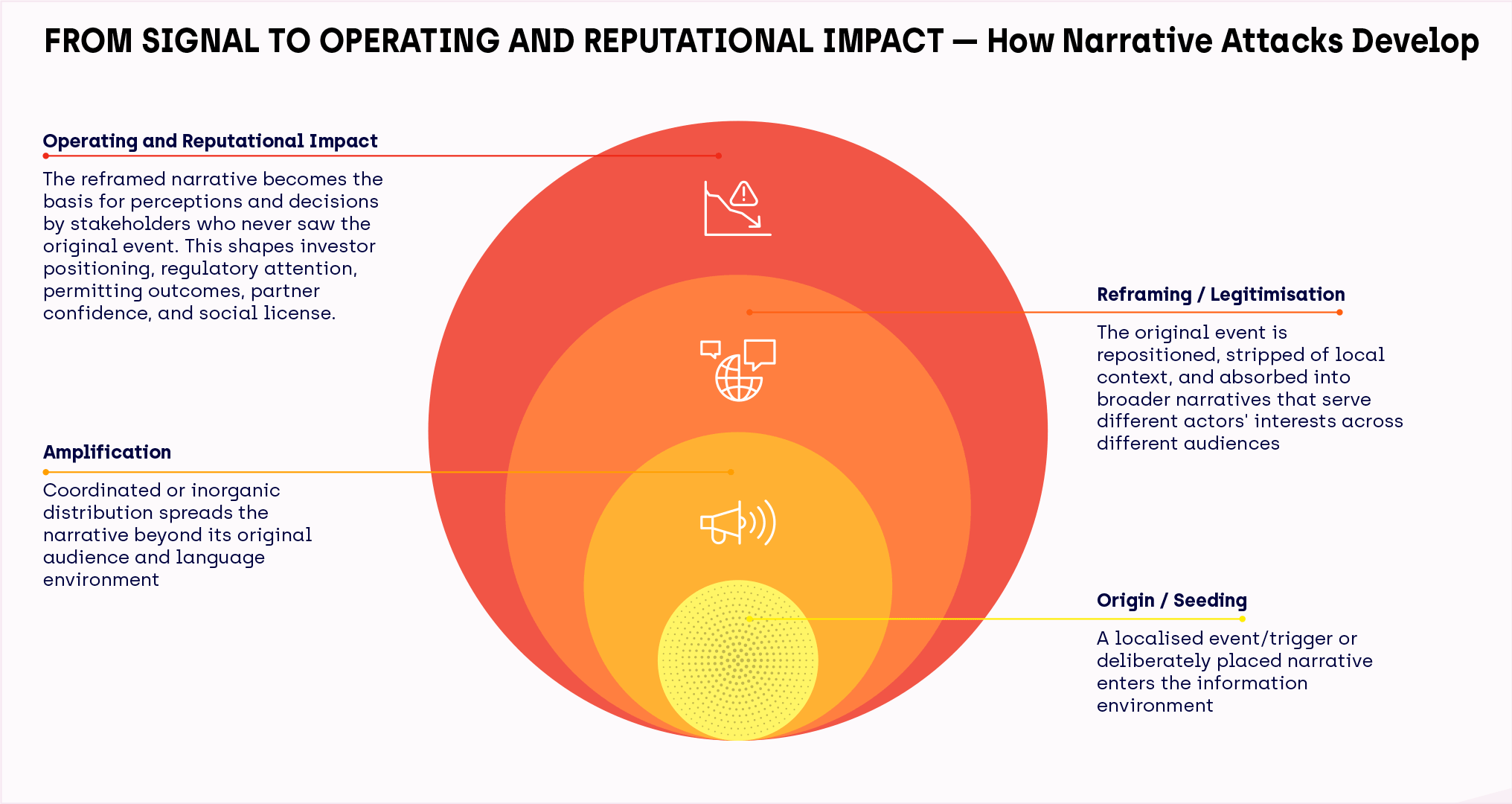
Across the cases in this briefing, Alto mapped a consistent sequence through which narrative threats develop around mining operations.
A localised event, whether a labour dispute, a policy announcement, a blockade, or a regulatory review, enters the information environment in the language of its origin. Within hours to days, it is picked up by state-aligned media, geopolitical commentary networks, or coordinated distribution channels and reframed for audiences far removed from the original context. A union deadlock becomes evidence of supply chain fragility. A community water rights grievance becomes "green colonialism." A tax renegotiation becomes a sovereignty milestone or an expropriation risk, depending on which audience is being targeted. By the time the reframed narrative reaches English-language commodity desks, investor briefings, or regulatory discussions, the perception baseline has already been set by actors whose interests have nothing to do with the asset, the community, or the commodity.
The organisations that had visibility into this sequence as it unfolded had a structural advantage while the ones that didn't were responding to framings that had already been established.
Most mining organisations operate across dozens of languages, hundreds of communities, and complex regulatory jurisdictions. But their monitoring infrastructure typically covers a fraction of the information environments where narrative threats originate. When an APM network reframes a community dispute in Russian-language Telegram channels, seeds synthetic amplification across French-language African media, or coordinates Mandarin-language policy narratives across industry forums, the operators most affected are often the last to know, because the manipulation is happening in languages, on platforms, and at a level of digital coordination they have no visibility into.
The cases in this briefing show what happens in that gap. Labour disputes, royalty reviews, environmental consultations, security reviews, each became a narrative multiplier not because the underlying events were fabricated, but because APM networks reached the relevant audiences first, in their languages, on their platforms, with framings designed to serve interests entirely unrelated to the asset or the community. The narrative attack surface is growing as mining operations become more automated, more digitally visible, and more concentrated in jurisdictions where these networks are already active. The organisations that close this visibility gap will build the muscle to detect threats at the point of origin and manage cognitive and narrative risk. The ones that don't will be managed by it.
The cases in this briefing share a common pattern: by the time operators, investors, or institutions saw the narrative, the framing was already set. Alto exists to close that gap.
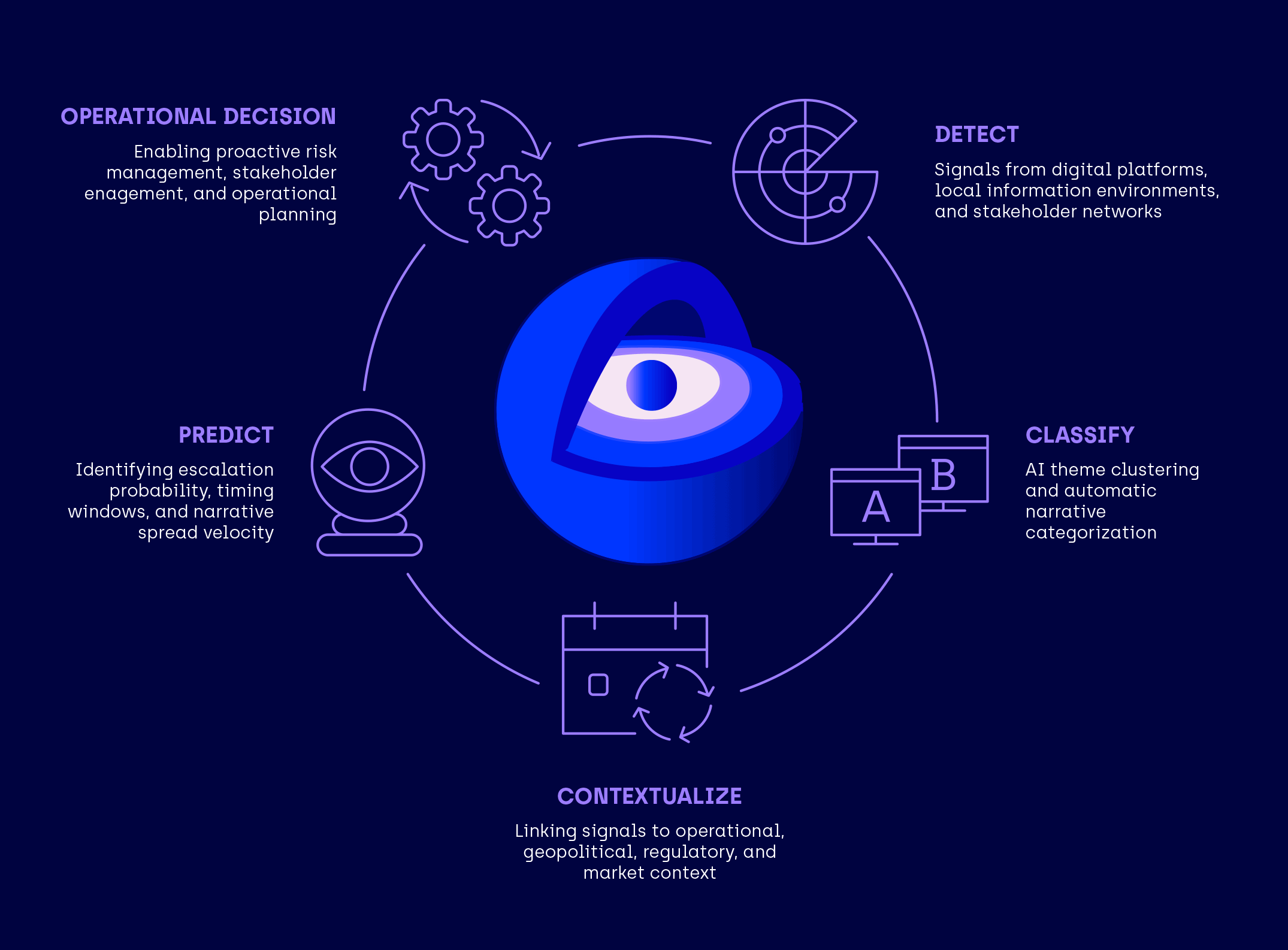
Alto works with some of the world's largest critical infrastructure, energy, and mining organisations to surface cognitive and narrative threats before they reach the stakeholders whose decisions affect permitting, financing, partnerships, and social license. Our intelligence infrastructure processes over 700 billion signals annually across 50+ languages and 125+ countries, from the grey-space channels where narrative threats originate to the mainstream sources where they reach decision-makers. Mining-specific data lakes, adversary-specific metadata, and DISARM-aligned classification enable our Virtual Intelligence Analysts to distinguish between organic community concern and coordinated APM campaigns in real time, giving operators the visibility to respond on their own terms, not on someone else's framing.
Recently named a Front-Runner in Disinformation Security by Gartner, Alto is expanding what's possible at the cognitive security perimeter.
This article provides a summary of Alto's findings. The full Mining and Critical Minerals Intelligence Briefing includes detailed case studies across all 10 Mining Indaba trends, named assets and operators, actor identification, DISARM TTP classification, and documented examples of cross-platform manipulation, synthetic amplification, coordinated inauthentic distribution, identity bombing, narrative laundering, and information flooding across multiple languages and platforms.
Organisations across mining, critical infrastructure, energy, and relevant sectors interested in learning more can request access to the full report or book a briefing with Alto's intelligence team.
Request the full report or book a briefing with Alto's team here