


Speak with an expert and get to know our technology.
COLLABORATE WITH US





Alto’s identified 148 companies exposed through Rybar-linked cognitive campaigns across defense, critical infrastructure, energy, finance, healthcare, transport and logistics, and technology sectors. Rybar is a Russian state-linked media network, sanctioned and designated by Western governments, that has evolved into persistent influence infrastructure creating exposure for companies and institutions across regions and languages.
➡️ A one-page summary of the findings is available for download here.
💻 REACH OUT TO OUR TEAM FOR THE FULL BRIEFING
Most companies that surface in state-linked influence campaigns never chose a side in any geopolitical dispute. They are weaponized through framing that is not theirs: pulled into sanctions narratives, resource-sovereignty claims, and infrastructure-vulnerability frames built by networks they have never engaged with, and the frame is usually established before anyone inside the company has seen it.
Alto's 2026 analysis of the Russian-linked Rybar network identified 148 companies in Rybar-linked cognitive campaigns across defense and aerospace, critical infrastructure, energy, oil and gas, financial services, transport and logistics, healthcare and pharma, and tech, AI and cyber.
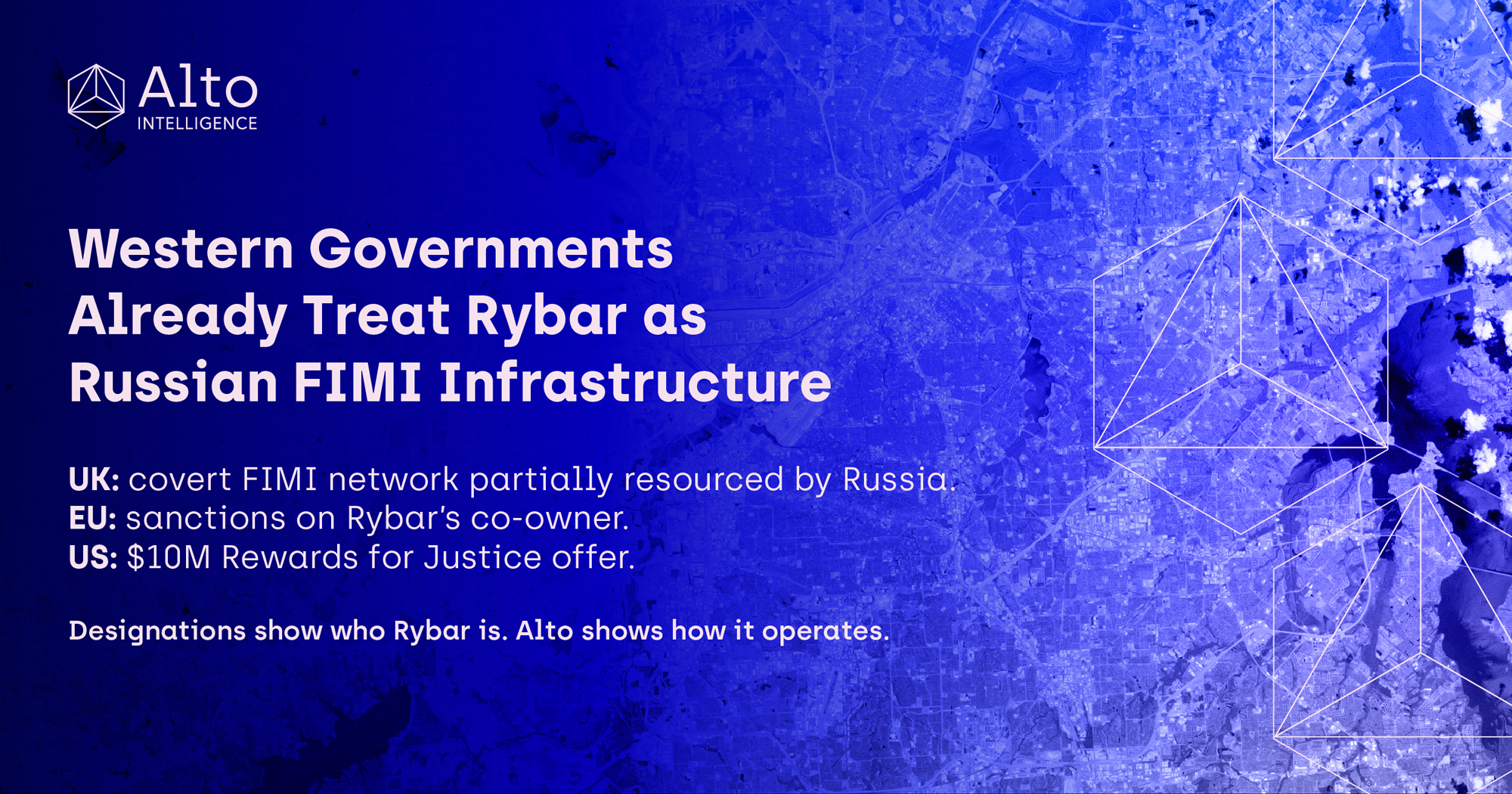
Rybar is a Russian state-linked military and geopolitical media network that has evolved into a persistent influence infrastructure spanning regional nodes, multilingual channels, and affiliated distribution surfaces. It is also formally designated: the UK named Rybar LLC a covert foreign information manipulation and interference (FIMI) network in December 2025, the EU has sanctioned its co-owner, and the US has offered a $10 million Rewards for Justice offer for information on Rybar and named employees. Built around a prominent Russian military-analysis brand, the network combines geopolitical commentary, battlefield reporting, localized narratives, and coordinated cross-platform distribution, giving it the ability to shape how events, institutions, sectors, and companies are interpreted across different audiences and information environments.
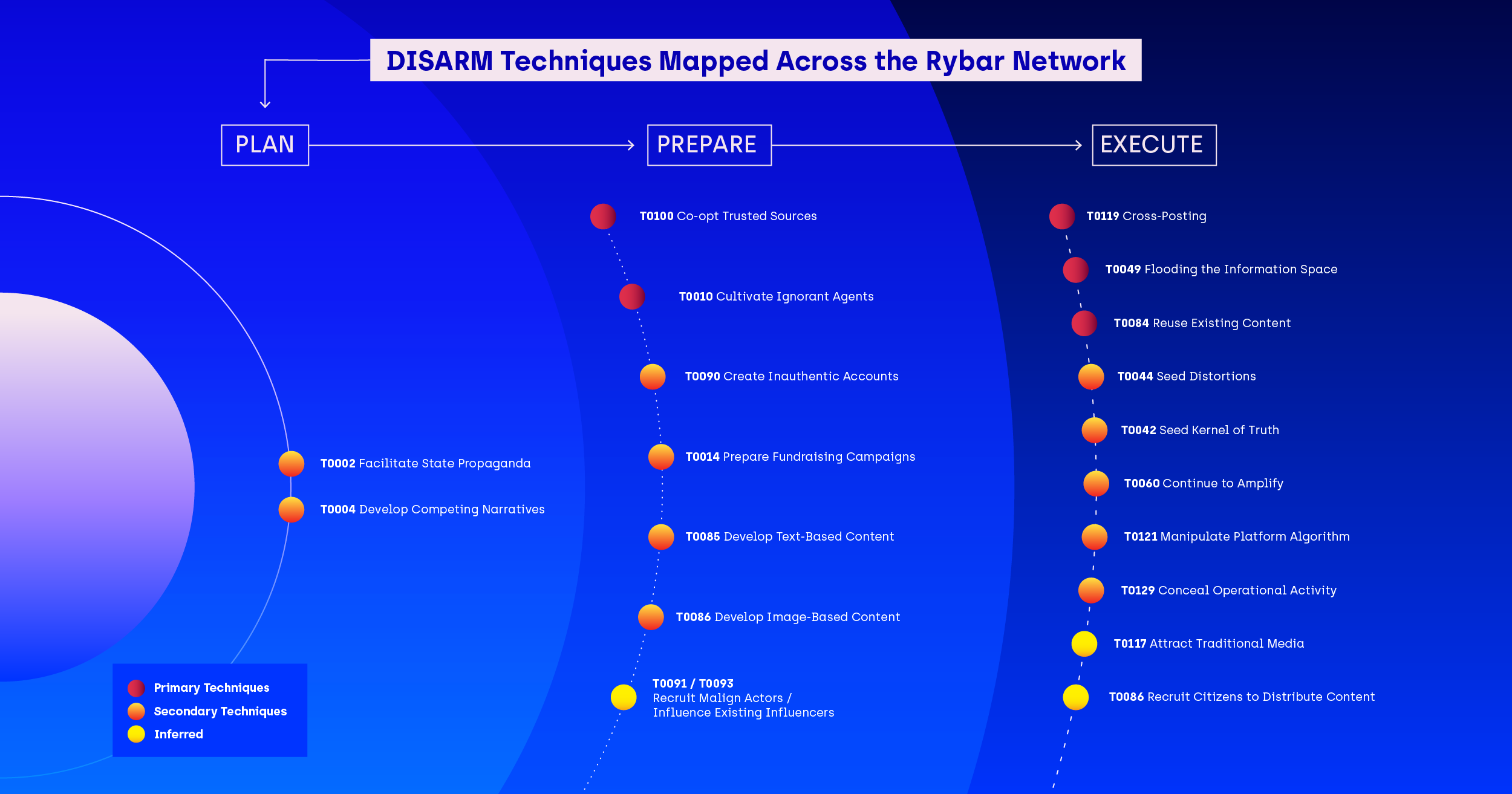
Alto has been mapping Rybar across its branded core throughout distinct analyses in 2026, some of which have been published already including research on drone incursions in European airspace, critical minerals and mining narratives, and data centres and AI infrastructure. This analysis explains how Rybar and APM architecture works at the operational level, highlighting a network of regional nodes, language editions, and tactical anchors carrying a combined following of over 2 million across Telegram and other digital media accounts. Across that infrastructure, Alto analyzed 19,135 messages and thematic signals from text, image, and video content, classifying each by sector and mapping observed behaviors against the DISARM Framework. The story here is the operating model, and Rybar illustrates how Advanced Persistent Manipulator networks work in practice.
Advanced Persistent Manipulators are prepositioned influence systems built to persist across events, reactivate around new triggers, and move narratives across regions, languages, and audiences.
The category is applied by analogy with Advanced Persistent Threats in cybersecurity. The point is persistence. APMs do not need to build a new audience, distribution system, or credibility layer each time a geopolitical trigger appears. The infrastructure is already there.
Across the networks Alto tracks, six features recur, and each is a test the Rybar case can be held against:
Persistent infrastructure that remains active between events.
Regional adaptation that localizes narratives for specific audience environments.
Multilingual distribution that moves aligned frames across language markets.
Credibility and amplification layers that reinforce, mirror, and extend the frame.
Reusable activation around real-world triggers such as sanctions, migration, energy shocks, regulatory disputes, security incidents, supply disruptions, or corporate controversies.
Corporate and institutional exposure that pulls companies, sectors, assets, suppliers, and operating environments into geopolitical narratives.
In the Rybar case, Alto observed this operating model across several layers: persistent regional and linguistic infrastructure, repeated synchronization patterns, credibility and amplification surfaces, and corporate and institutional exposure across exposed sectors. Below is a breakdown of what they look like in practice.
➡️ A one-page summary of the findings is available for download here.
The first test is whether the network exists beyond individual campaigns.
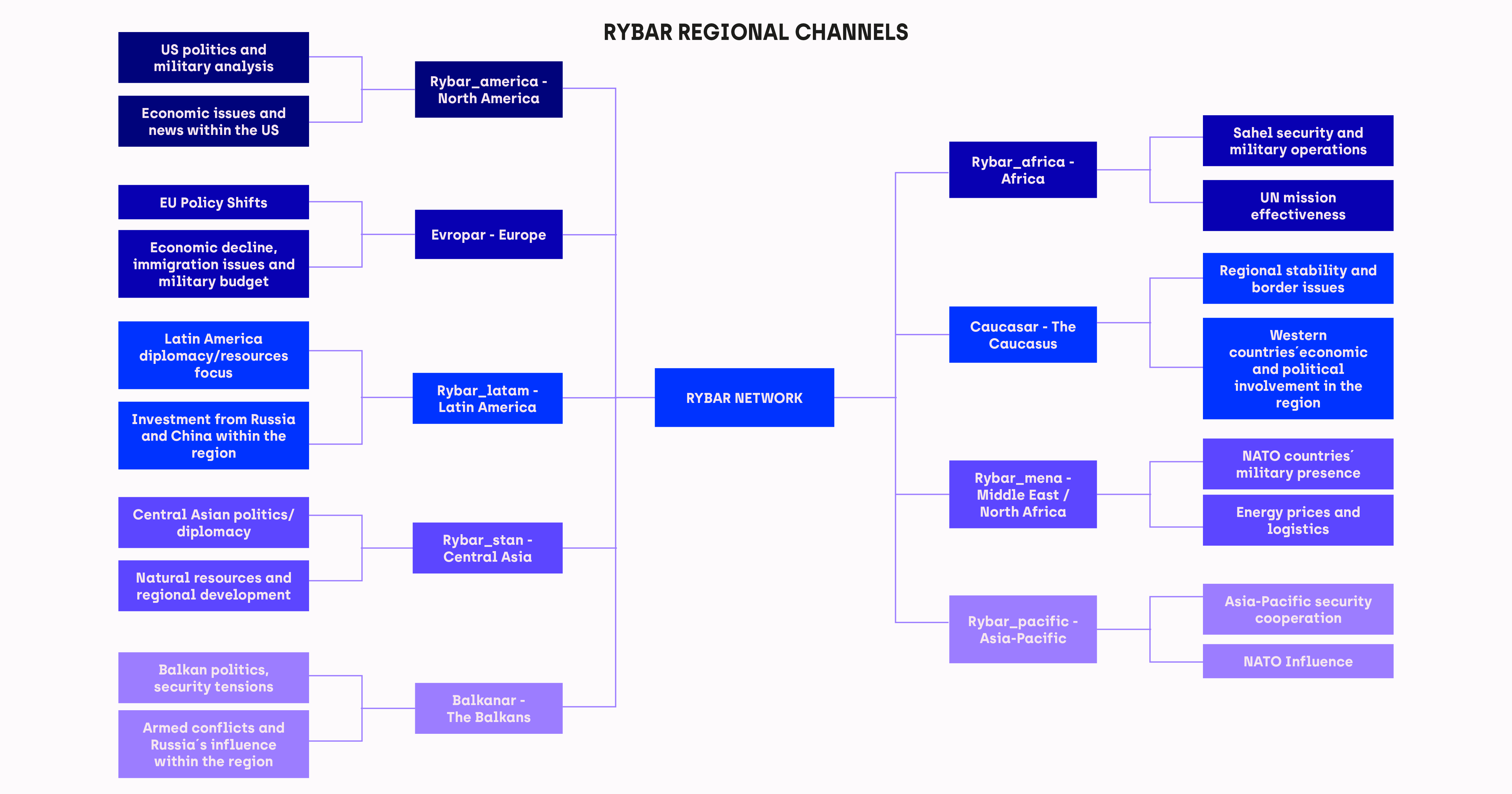
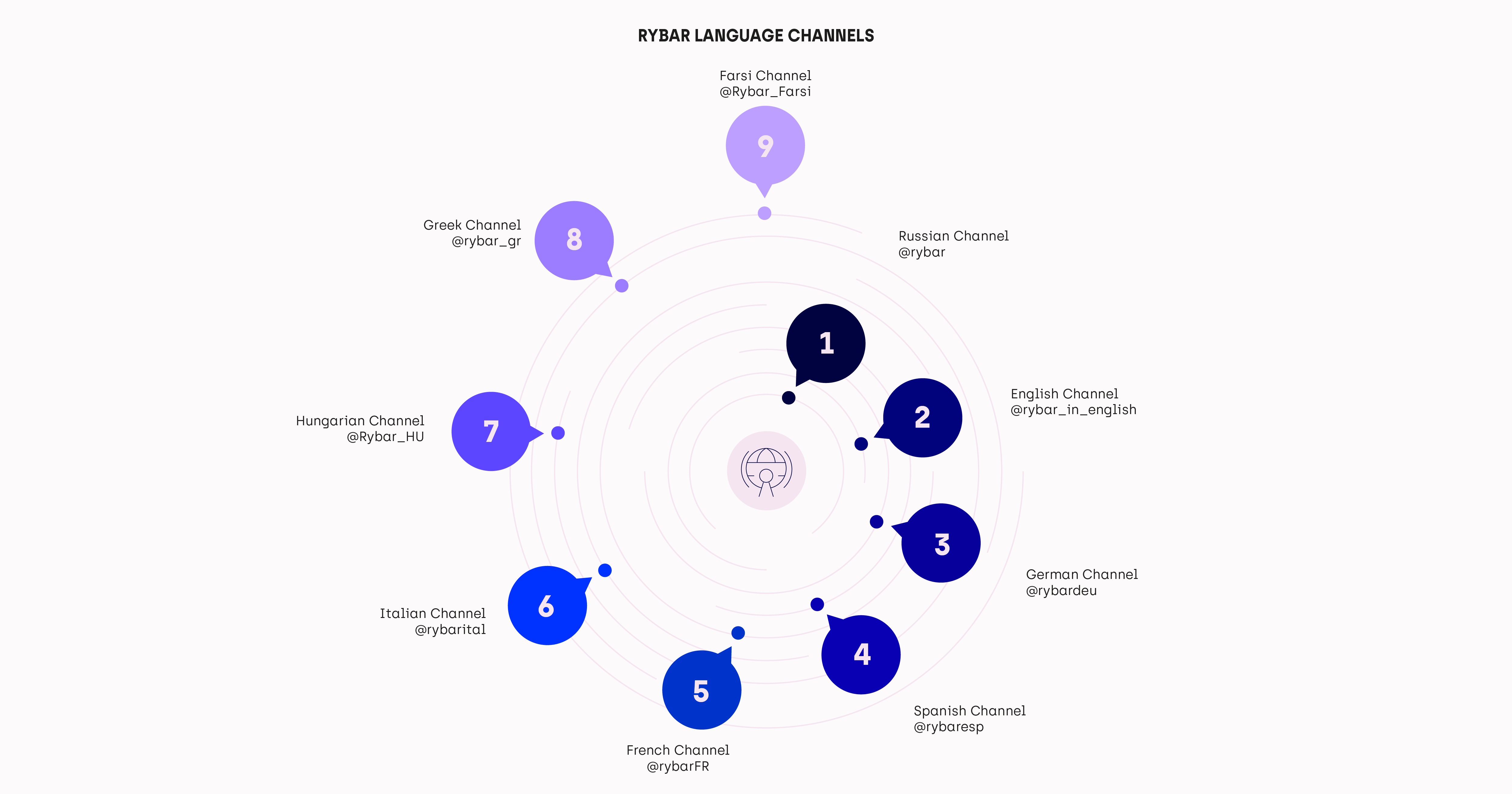
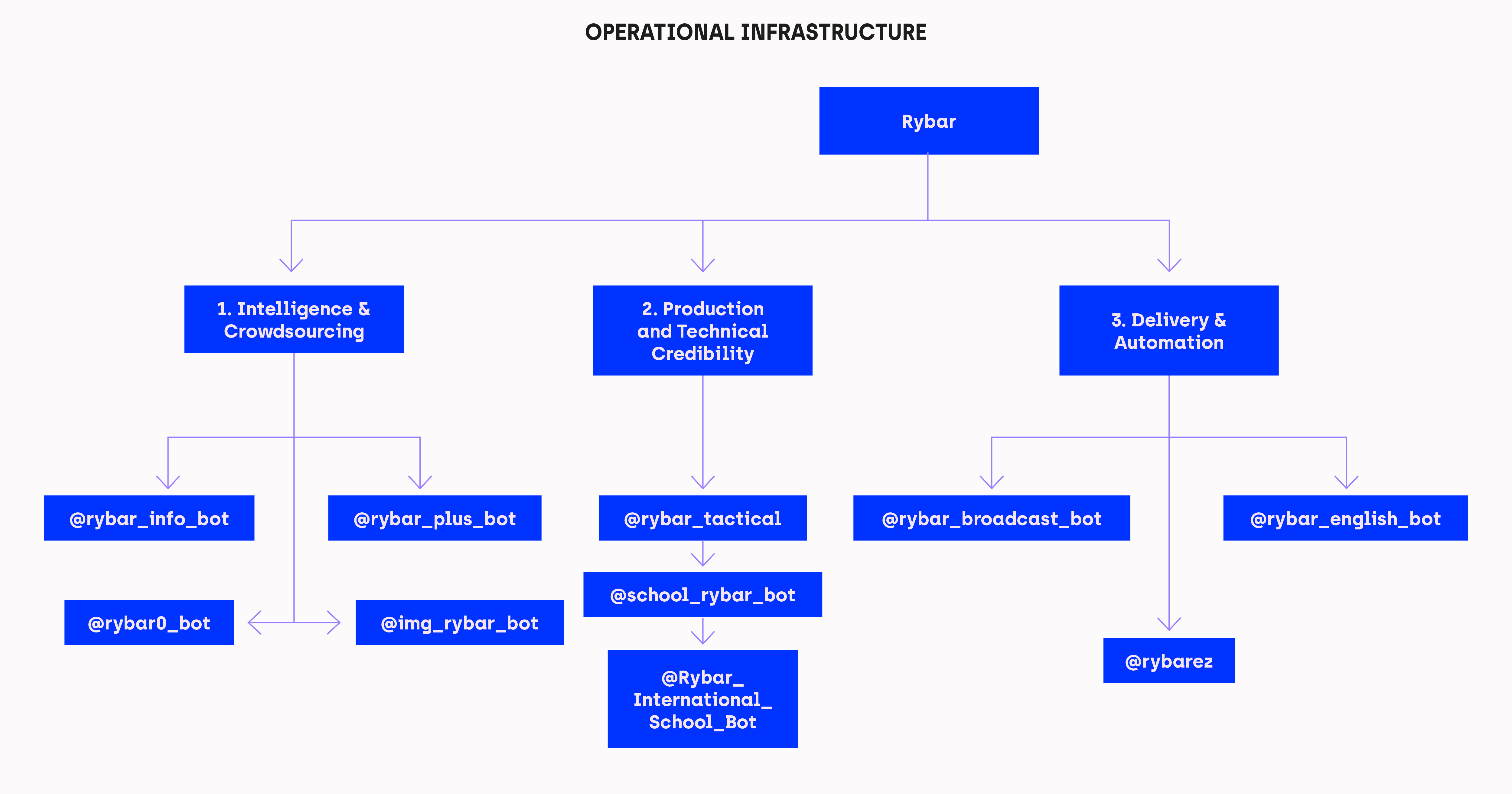
Between January and March 2026, Alto mapped 18 directly operated surface entities: nine regional adaptation nodes and nine language channels. These were supported by bots, mirrors, credibility surfaces, recruitment infrastructure, and affiliate ecosystems.
The branded core, spanning regional nodes, language editions, and tactical anchors, carries a combined following of over 2 million across Telegram and other digital media accounts as of August 2026.
The mapped surface understates total reach. Downstream affiliates, mirror channels, Media School-linked operators, and derivative outlets extend distribution beyond the charted channels. This is persistent influence infrastructure.
💻 REACH OUT TO OUR TEAM FOR THE FULL BRIEFING
The second test: can the network adapt narratives to different audience environments?
APMs localize the frame, and localization is where the leverage is. The same underlying claim arrives as resource sovereignty in one region, anti-colonial resistance in another, and institutional weakness in a third. Each version fits the grievance structure of the audience it reaches, while the strategic direction stays centrally aligned. Regional nodes make that possible. They sit between the source narrative and wider distribution, adapting the frame before it moves.
For companies and institutions, this is why exposure is uneven. The same company, supplier, asset, or operating environment is elevated differently depending on which theater and which audience the network is addressing at that moment.
💻 REACH OUT TO OUR TEAM FOR THE FULL BRIEFING
Third, speed. The test is whether localized frames can move across language markets before responses form.
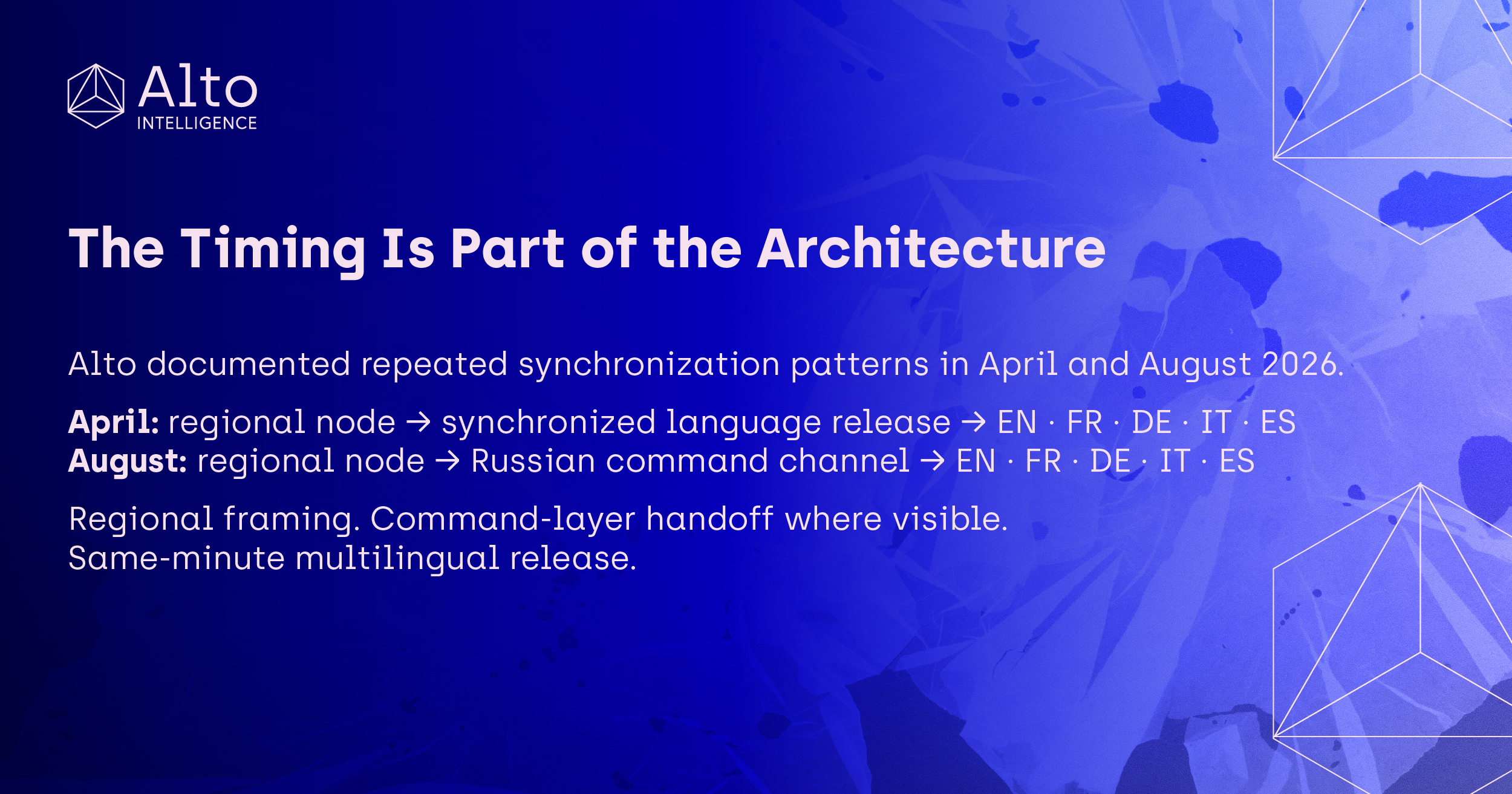
In Alto's timestamp audits, the pattern repeats: a frame is set regionally, handed into the command layer, and released across language channels in compressed windows, with publication aligned to the same minute. The timing is the architecture. Minute-level alignment across languages is what separates coordinated syndication from ordinary reposting.
By the time competing accounts are available, the aligned interpretation is already moving through multiple language environments at once.
The fourth test looks past the primary channels to the reinforcement layers behind them.
The visible channel is the smallest part of the system. Around it sit credibility surfaces that give the framing the authority of operational reporting, mirrors that preserve availability when channels are blocked, and affiliate and recruitment pathways that extend distribution while appearing independent of the core brand.
This is why monitoring the original channel arrives late. By the time a narrative is visible to an affected organization, it has typically been localized, syndicated across languages, reinforced through credibility surfaces, and routed through affiliates and mirrors. The durable risk is the architecture that keeps content moving, not any single piece of content.
💻 REACH OUT TO OUR TEAM FOR THE FULL BRIEFING
The fifth test is reactivation: whether the infrastructure can turn to new events.
This is where APMs break the assumptions most monitoring is built on. A campaign has a beginning and an end. Infrastructure has neither. When a border incident, outage, regulatory dispute, corporate controversy, energy shock, sanctions decision, or supply disruption occurs, the network that will frame it already exists: audience assembled, channels warm, credibility surfaces in place. The event supplies the trigger; everything else is already running.
Activation is fast because nothing needs to be built. The event is interpreted through a regional lens, moved into wider distribution, and syndicated across languages while the facts are still unsettled. Old narratives are revived when new events make them useful again. The resulting frame can reach relevant audiences before official accounts have stabilized, and before the affected actor understands it has been pulled in at all.
Alto identified 148 companies in Rybar-linked cognitive campaigns across defense and aerospace, critical infrastructure, energy, oil and gas, financial services, transport and logistics, healthcare and pharma, and tech, AI and cyber.
A company does not need to be the original target of a campaign to become exposed. It can enter the frame through its sector, assets, suppliers, operating environment, regulatory position, infrastructure role, or association with a geopolitical event.
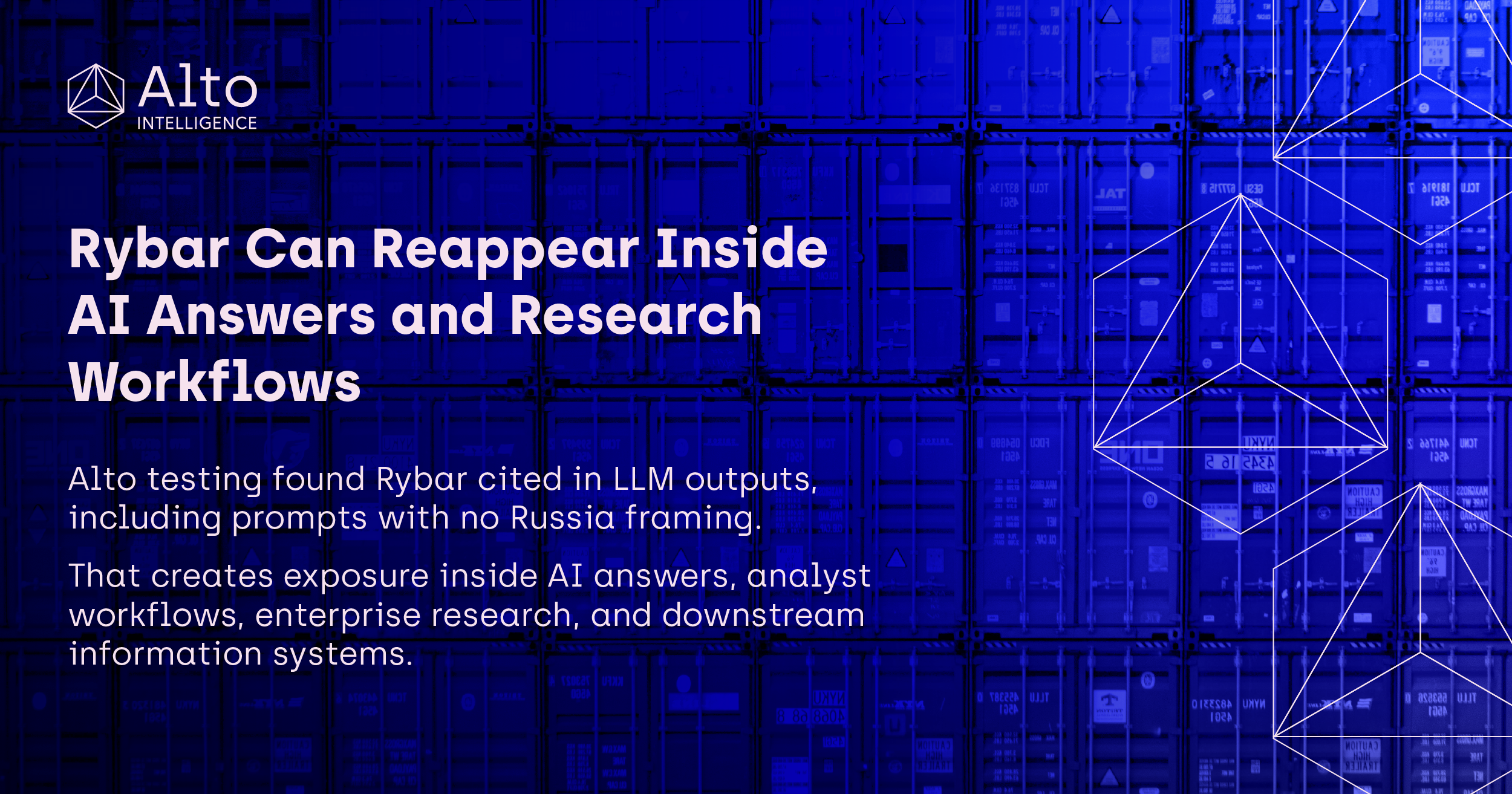
The exposure now extends into generative AI. In testing across major generative AI models, Alto found Rybar surfacing as a cited source in outputs on military operations and contested factual claims, including prompts with no Russia framing in the input. Analysts, journalists, and enterprise research workflows querying an LLM for context can receive state-linked framing served as sourcing, and agentic systems can carry that sourcing into downstream work without human review at the point of citation.
For public institutions, infrastructure operators, and companies in exposed sectors, the risk begins before the controversy is visible, across both human and machine-facing information layers. Public, regulatory, market, and security reactions can begin forming while teams are still verifying facts and aligning response.
Monitoring for mentions, rebutting individual claims, and other traditional communications responses arrive too late in that cycle. They answer content while the operating risk sits in the infrastructure that produces it.
➡️ A one-page summary of the findings is available for download here.
APM networks create a different kind of risk.
They shape the environment in which institutions, companies, regulators, investors, media, and security actors interpret events, well before any single claim lands.
Before a company, asset, supplier, or operating environment reaches mainstream debate, the frame may already have been seeded, localized, and syndicated across Advanced Persistent Manipulator networks.
The organizations that can see this sequence as it unfolds have a structural advantage. The ones that cannot are left responding to framings that have already been established.
💻 REACH OUT TO OUR TEAM FOR THE FULL BRIEFING
Alto works with some of the world’s largest critical infrastructure, energy, mining, defense, public-sector, and global enterprise organizations to surface cognitive and narrative threats before they reach the stakeholders whose decisions affect operations, regulation, financing, security, reputation, and institutional trust.
Alto’s intelligence infrastructure processes over 700 billion signals annually across 50+ languages and 125+ countries, from the gray-space channels where narrative threats originate to the mainstream sources where they reach decision-makers.
Adversary-specific metadata, sector-specific data lakes, and DISARM-aligned classification enable Alto’s analysts and Virtual Intelligence Analysts to distinguish between organic debate, opportunistic amplification, and coordinated Advanced Persistent Manipulator activity in real time.
Alto is recognized by Gartner as one of the top five companies globally in narrative intelligence, and the only one headquartered in the European Union. This positioning reflects Alto’s role in helping organizations understand, detect, and respond to cognitive threats as they move across languages, regions, sectors, and decision environments.
This article provides a summary of Alto’s findings. The full Rybar briefing includes detailed network mapping, regional and linguistic architecture, actor infrastructure, sector exposure, DISARM TTP classification, timestamp audits, and documented examples of synchronized multilingual activation.
Organizations across defense and aerospace, critical infrastructure, energy, oil and gas, financial services, transport and logistics, healthcare and pharma, tech, AI and cyber, and relevant public-sector environments can request access to the full report or book a briefing with Alto’s intelligence team.
💻 REACH OUT TO OUR TEAM FOR THE FULL BRIEFING
🗯️ FOLLOW ALTO ON LINKEDIN
➡️DOWNLOAD RYBAR 1-PAGER